

Why Parking Ventilation?
Automobile parking garages can be either fully enclosed or partially open. Fully enclosed parking areas are often underground and require mechanical ventilation. Partially open parking garages are generally above-grade structural decks having open sides (except for barricades), with a complete deck above. Natural ventilation, mechanical ventilation, or a combination can be used for partially open garages.
Operating automobiles in parking garages present two concerns. The more serious is emission of CO, with its known risks. The other concern is oil and gasoline fumes, which may cause nausea and headaches and also represent potential fire hazards. Additional concerns about NOx and smoke haze from diesel engines may also require consideration. However, the ventilation rate required to dilute CO to acceptable levels is usually satisfactory to control the level of other contaminants as well.
Ventilation requirements for these facilities are provided for climate and temperature control, contaminant level control, and emergency smoke management.
One of the aims of operating a ventilation system is to dilute the vehicular exhausts by introducing uncontaminated air and extracting the mixture away from the enclosure. In many projects, calculation of the amount of outdoor air required relied on the “well-mixed” condition. However, mixing depends on the air flow patterns where the locations of supply points and extraction points of the ventilation system would be important.
Types of Parking Ventilation systems
Ducted
The ventilation of underground car parks based on a ductwork system provides the exhaust of contaminated air and the admission of fresh air. In order to avoid under ventilated stagnation zones of the flow, the inlet and outlet openings should be equally distributed in the car park. These systems are expensive due to the cost of the necessary equipment, the large space occupied by the ductwork and the significant head losses in the ductwork.
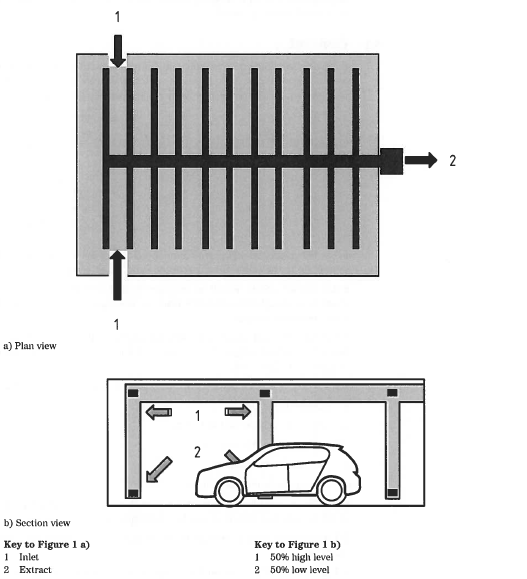
The dispersal of high concentrations by removal or dilution will be dependent on the effectiveness of the ventilation system. Mechanical ventilation systems for enclosed car parks can be classified as
(a) supply-only systems
(b) exhaust-only systems
(c) combined supply and exhaust systems.
Combined systems can provide control of both supply and exhaust functions. Such systems allow more control of the distribution of intake (outside) air and, by adjustment and balancing, can prevent uncontrolled migration of polluted air to other parts of the car park. Car park ventilation systems can also be classified according to air flow pattern as unidirectional (displacement) systems – in which the supply and exhaust locations are arranged to establish an overall flow through a significant volume of the car park, and multidirectional (mixing) systems – in which supply and exhaust points are arranged so that a number of relatively small flow fields are established over relatively short distances.
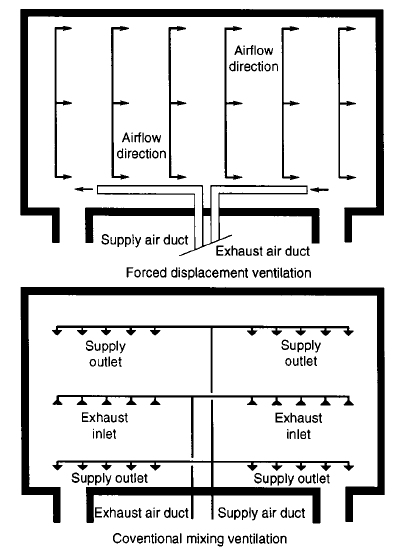
Properly designed and maintained unidirectional systems can provide a sweeping action which moves pollutants quickly to the exhaust vents. A disadvantage of such systems, particularly in large area car parks, is that high pollutant gradients can be established, as the supply air is contaminated sequentially and cumulatively as it flows towards the exhaust side. This can result in high pollutant levels in areas near the exhaust vents.
Multidirectional systems provide sources of outside air for the dilution of pollutants, and when properly designed and operated can provide for more ‘localized’ control of pollutants. However, such systems increase the likelihood of short circuits in the ventilation flow. For example, if supply and exhaust grills are too closely coupled, air can flow from the supply grill to the exhaust grill without adequate mixing with the pollutant-laden air in the region of the flow path. This can result in a significant volume of air being moved, but limited impact on overall pollutant loading.
Impulse ventilation (jet fans)
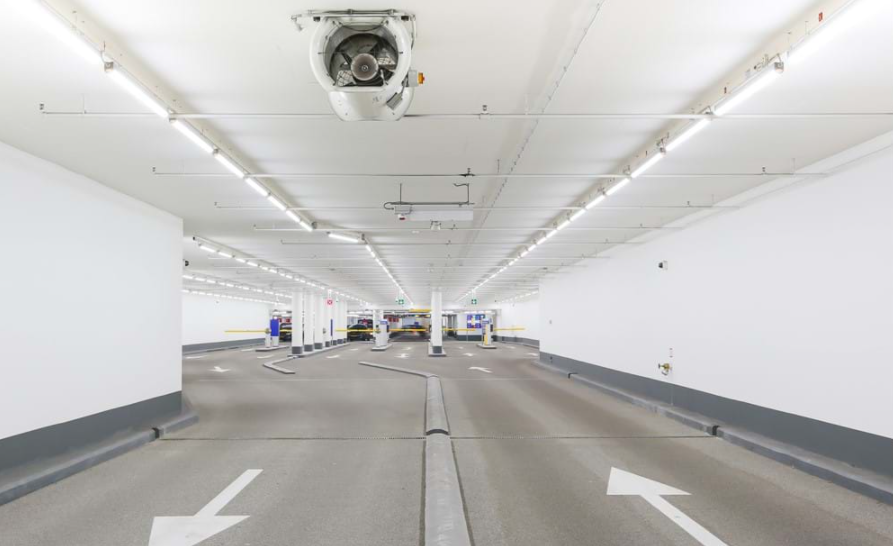
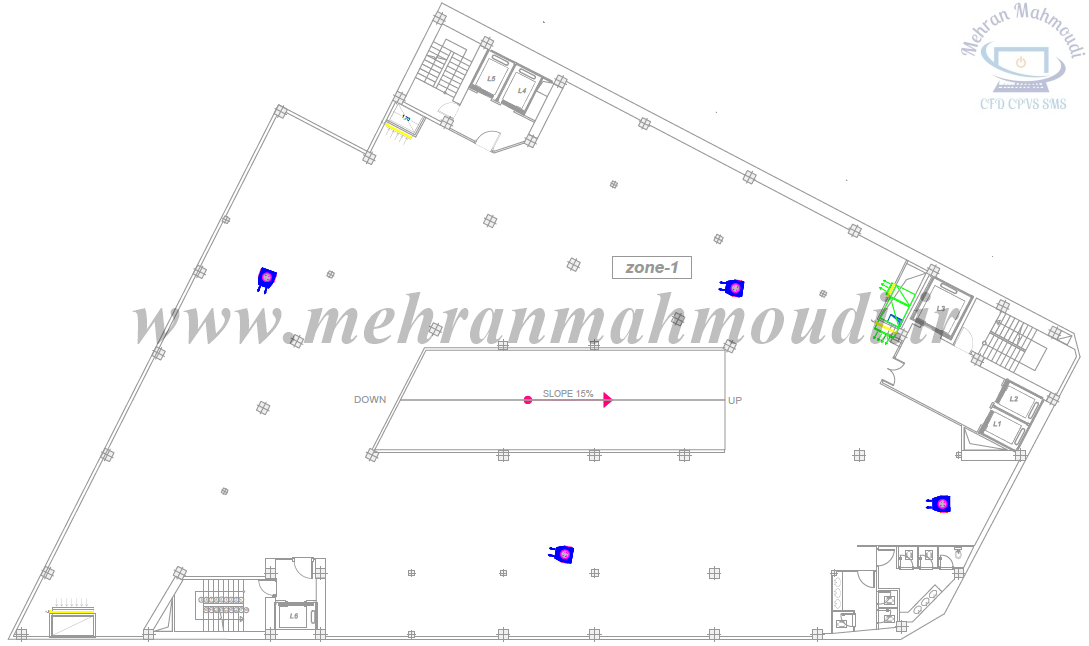
The most significant development in car park ventilation design has been the introduction of Impulse Ventilation. It is an innovative alternative to traditional systems and provides a number of significant benefits. An Impulse Ventilation System is based on a number of small high velocity jet fans that either replace traditional distribution ductwork in closed car parks or increase cross-flow ventilation in open car parks. In this way, the inlets and outlets may be concentrated in some points of the underground car park. Usually the exhaust of polluted air is carried out by a number of axial ventilators located in shafts in the periphery of car parks. In some cases, similar ventilators are used for the admission of fresh air. Consequently, their benefits include installation flexibility and potentially lower operating and maintenance costs.
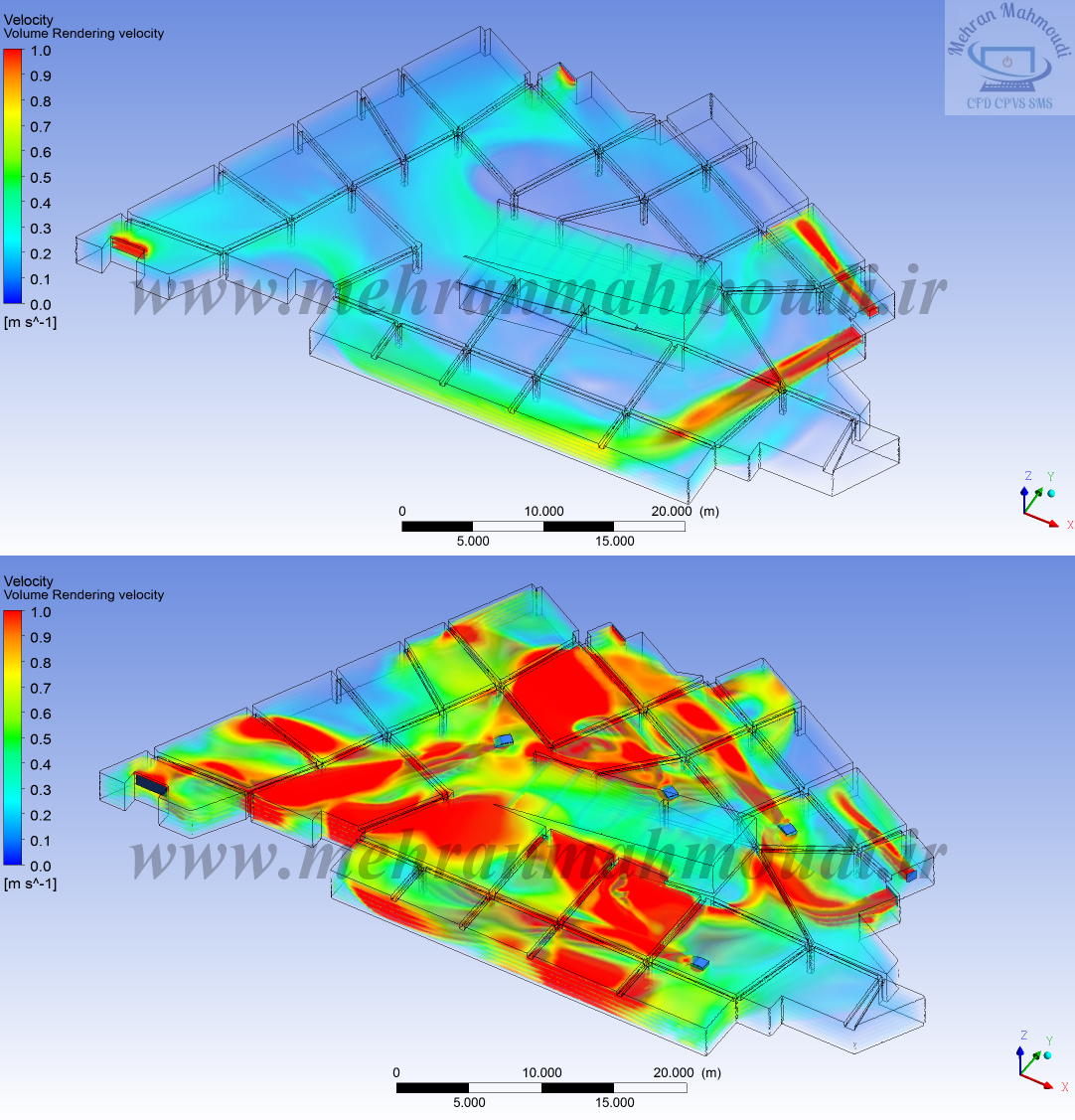
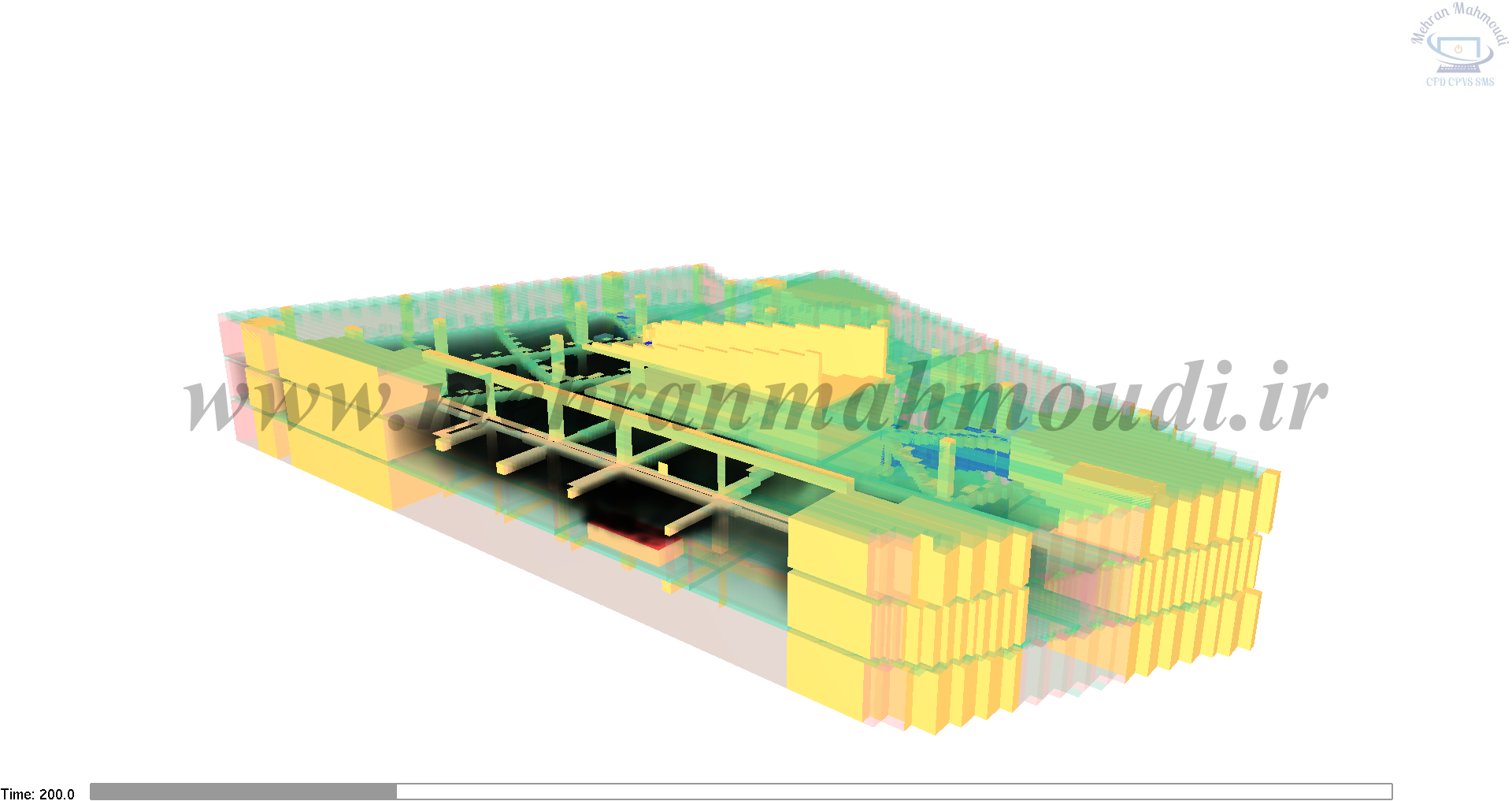
Design of impulse systems is usually proven by use of CFD (Computational Fluid Dynamic) analysis.
Design Guides:
To fulfil air quality and thermal comfort requirement for users in an underground car park, many design guides on mechanical ventilation are available in literature such as ASHRAE.
For many years, the various model codes, ANSI/ASHRAE Standard 62.1, and its predecessor standards recommended a flat exhaust rate of either 1.5 cfm/ft2 or 6 ach for enclosed parking garages.
However, ANSI/ASHRAE Standard 62.1 and the International Code Council’s International Mechanical Code® (ICC 2009a) allow 0.75 cfm/ft2 ventilation, whereas NFPA Standard 88A recommends a minimum of 1.0 cfm/ft2.
The use of CFD in design:
Unsatisfactory design of mechanical ventilation systems in car parks would give poor indoor environment.
In early age of construction, the most of building related issues such as ventilation analysis were conducted by the wind tunnel tests, but today all these test can be done effectively with CFD technique. CFD technique can resolve all above mentioned issues in very short time period and it is very economical as well as strong approach than the older one (experimental).
Prediction of the effect of the IVS is usually made using CFD calculations and the improvements (when necessary) are assessed by CFD on a trial and error basis.
Proper placement of jet fan units at a car park, given its layout floor plan, requires expert knowledge of both HVAC and fluid dynamics. Indeed, whereas in tunnels jet fans are used just to drive the flow and avoid backlayering, in car parks, due to the large area of the compartments, the flow patterns are much more complex and jet fans should also avoid lateral dispersion of the smoke. Because jet fans are free-standing, the risk for air recirculation around the fan is quite high. Therefore, poorly chosen jet fan locations may actually hinder fresh air ventilation.
Computational Fluid Dynamics (CFD) is a helpful tool to predict the expected flow patterns and to verify if spread of smoke occurs and if exist some stagnant zones very critical to control CO concentration. CFD ensures system optimization and, more importantly, that occupants' safety is not compromised. This avoids making a project extremely expensive by using too many fans, or an under performing system by specifying too few.